Nobody warns you that the first thing inline skating teaches you is how to fall. Every skater has the same origin story: a wobble, a flailing arm, and a quiet moment on the pavement wondering why you chose wheels over shoes.
That shared humility is exactly why skeletons and skating feel like a natural pair. A skeleton is what is left when everything fragile is stripped away, and yet it keeps moving. It is a fitting mascot for a sport built on scrapes, comebacks, and getting up one more time.
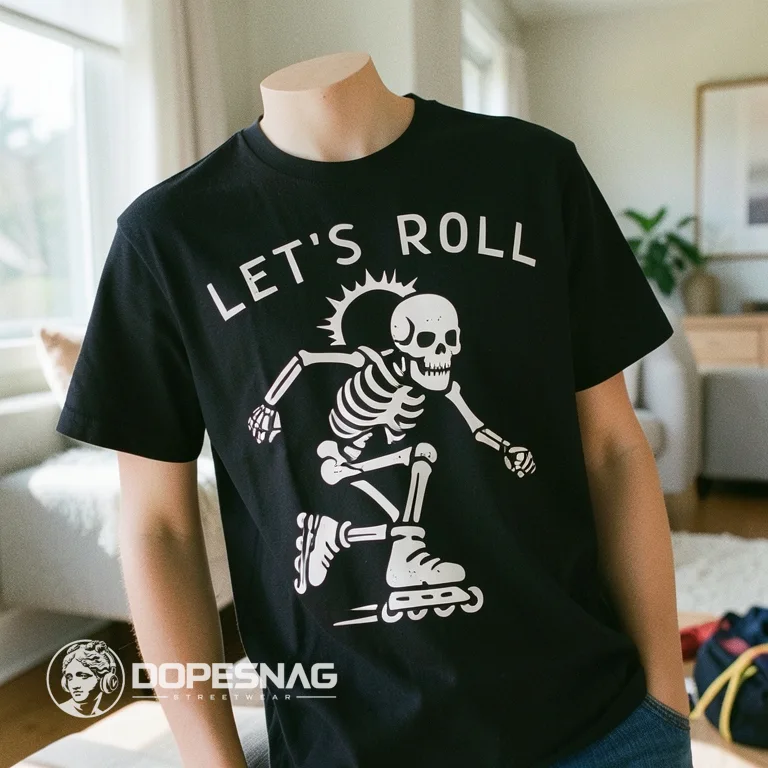
That same spirit runs through the Let's Roll skeleton inline skating shirt, where the vintage distressed print makes the whole graphic look like it has already survived a few hundred miles of rough asphalt.
Inline skating has always carried a slightly rebellious streak. An early inline skate prototype is credited to inventor Joseph Merlin in the 1760s. The sport only exploded into street culture in the 1980s and 1990s, when rollerblading crews took over parking lots, boardwalks, and skate parks with neon colors and loud attitudes. Over time, the visual language drifted darker. Distressed lettering, grinning skulls, and horror-movie imagery became a shorthand for fearlessness on wheels.
The Let's Roll artwork leans into that tradition. A skeleton glides mid-stride in a weathered, vintage-print style, as if the graphic itself has been through a few hundred miles of rough asphalt. There is no polished gloss here. The grin does the talking, and the message is simple: keep rolling, whatever the pavement throws at you.
It is a small tribute to the oddly joyful side of horror, where the scariest figure in the room is also the one having the most fun.